
New Braunfels City Directory Holdings
New Braunfels historical directory research begins with a small, documented shelf rather than a complete online run. Sophienburg Museum & Archives identifies city-directory holdings for 1931, 1940, 1952–53, and later material from the 1960s through the 1990s. Its telephone examples reach 1928, 1937, 1945, 1947, 1950, and 1952. Each title is a time-stamped association between people, addresses, and local activity. The University of Texas catalog adds city, regional business, and telephone publications, while CCGS and TSLAC provide records that can test a directory lead. The collection table separates confirmed holdings from a catalog lead whose exact run still needs a shelf check.
| Collection | Years documented | Where held | How to use it |
|---|---|---|---|
| Documented local volumes | 1931; 1940; 1952–53; 1960s–1990s | Sophienburg Museum & Archives | Appointment research for dated name, address, household, or business context |
| Telephone directories | 1928, 1937, 1945, 1947, 1950, 1952 examples | Sophienburg and UT catalog holdings | Compare telephone and address associations before and after a city-directory year |
| Regional business directory | Exact run not located in the inspected sources | UT Briscoe Center catalog | Catalog lead for the Polk Seguin–San Marcos–New Braunfels title; verify the item |
| CCGS historical indexes | Census 1850–1930; reconstructed 1890; other named series | Comal County Genealogy Society | Use as a lead, then confirm with the underlying record |
A direct, publicly indexed scan of a 1931 New Braunfels city-directory entry was not located during research. That gap matters. It means a directory statement should identify its volume and year, and an archive appointment or catalog item should confirm the page and publisher before a result is treated as final.
New Braunfels Directory Research at Sophienburg
Sophienburg’s directory and research overview is the local starting point for this historical shelf. The archive combines directories with County Clerk records, Texas General Land Office material, more than 500 genealogies, and local newspapers on microfilm. Research access is by appointment, from 10:30 a.m. to 3:30 p.m., at 401 W. Coll Street. The archive contact listed by Sophienburg is 830-629-1572 and archives@sophienburg.com. Bring a name variant, an address, a date range, and the reason for the search. That gives staff a usable request without asking them to create a broad list of people.
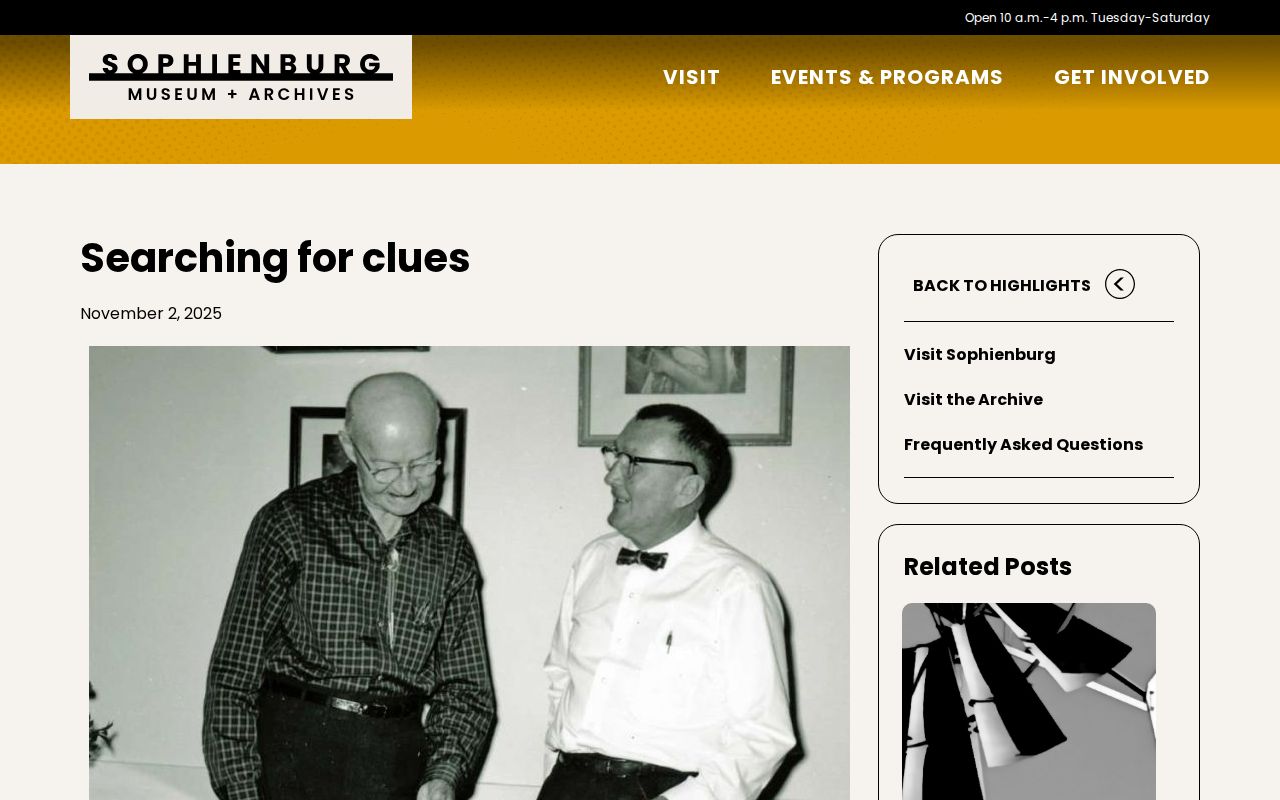
The archive’s own search method is useful because it treats a directory line as one piece of evidence. A surname can be checked against a newspaper notice, a land record, or a genealogy, while an address can be compared across more than one printed year. Sophienburg’s German-language holdings are especially important when a spelling shifts between English and German forms.
These volumes do not establish legal title. They may record a household, a business contact, or an address association. The County Clerk’s recorded deed and the directory’s date answer different questions, so both should remain in the research notes.
New Braunfels Directory Publishers at UT
The Briscoe Center’s New Braunfels directory catalog returned 12 location results in the research pass. It names Business Directory Publishing Co., Inc. for a local city-directory title and Polk City Directories for a Seguin–San Marcos–New Braunfels regional title. Telephone material in the catalog is associated with ATD-Nationwide, Guadalupe Valley Telephone Co-op, Johnson Publishing, Southwestern Bell/SBC, and United Directory/Transwestern. The catalog does not give a complete year range for every item, so publisher and date should be copied from the catalog entry or physical item rather than inferred from a title.
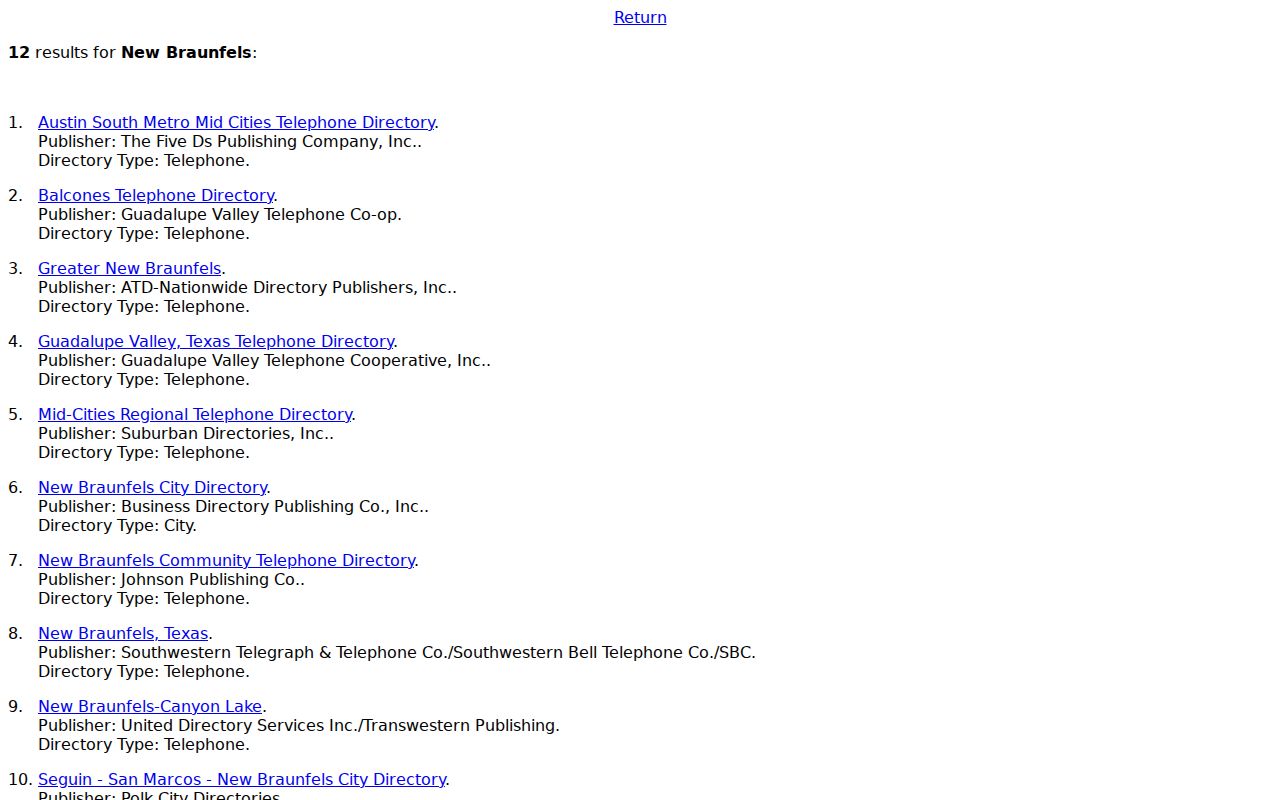
That catalog is a way to locate, not a substitute for, the printed volume. It can point to a regional book that catches a business or telephone listing absent from the local shelf. A New Braunfels directory search works best when the researcher records which publication supplied the result, whether it is city or regional, and whether the person was listed at a home or business address.
Reading New Braunfels Directory Evidence
The historic file for 794 W. Mill supplies a careful sample of what can be verified from historical directory evidence. It connects Theodore and Margarete Schwab with a 1923 telephone-directory appearance and a 1931 city-directory appearance, then places those associations alongside a plat and deed history. The source does not expose a newly transcribed page image, so it does not support guessing at a full set of printed abbreviations, occupations, or owner symbols. Preserve what the source actually states and mark the rest as unverified.
| Names | The historic file identifies Theodore and Margarete Schwab in the address discussion. |
|---|---|
| Street association | 794 W. Mill is tied to a 1923 telephone directory and a 1931 printed volume. |
| Directory placement | Directory year is verified; exact page, publisher, and abbreviation key were not located. |
| Role | The report describes owner and resident context, not a rule that every directory entry proves ownership. |
| Linked evidence | Henry Hoeke’s 1900 plat, later deed transactions, and Sanborn coverage beginning in 1922. |
- Criss-cross directory
- An address-ordered directory section, when a volume has one, used to move from a street to a listed name or business.
- Householder index
- A name-ordered aid that helps locate the principal household listing before an address comparison.
- Abbreviation key
- The volume’s own explanation of its shortened terms. No 1931 New Braunfels key was located in the inspected sources.
Note: Record the directory year, volume, page, and wording before joining it to a deed, map, or census source.
New Braunfels Directory and Map Dates
Directory dates make more sense beside the city’s map record. New Braunfels historic reports identify Sanborn coverage for 1907, 1912, 1922, 1930, 1949, and 1969. Sanborn sheets show building footprint, materials, use, streets, and hazards. They do not identify an owner or occupant. A dated directory captures an address and person or business association for its publication date, while a deed records a transaction and a map gives physical context. Keeping those roles separate prevents a historical address trail from becoming an unsupported statement about residence.
- 1907–1922: New Braunfels Sanborn editions establish early street and structure context, with 1922 the first coverage identified for 794 W. Mill.
- 1923: The 794 W. Mill historic file uses a telephone-directory association.
- 1931: Sophienburg identifies the earliest local directory in its holdings.
- 1940 and 1952–53: Further confirmed directory holdings provide later comparison points.
- 1960s–1990s: Sophienburg reports later directory material, while the exact volume and page still need individual verification.
The Dry Comal Creek historic report offers another caution. It found no directory address for the site from 1952 through 2016, even though earlier Sanborn maps showed industrial or commercial uses. A negative result can mean a renamed, commercial, unaddressed, or differently indexed place, not that the place had no history.
Tracing New Braunfels City Directory Households
Use a New Braunfels local directory as a dated stop in a household trail. Begin with the first year close to the known event, then move forward or backward through the confirmed holdings. CCGS publications add local census material from 1850 through 1930, including a reconstructed 1890 census, while its marriage, cemetery, naturalization, and probate work can supply independent checks. The aim is not to flatten those sources into one profile. It is to state exactly what each says about one name, address, or family at a particular time.
- Search the closest confirmed city-directory or telephone-directory year for the person and address.
- Copy the printed name and address exactly, including initials and spelling variants.
- Check the next available local directory year and note a move, a business address, or an absence.
- Pair the dated listing with the nearest CCGS census or original census source, keeping the census household separate from the directory entry.
- Use a deed, cemetery record, obituary, church record, or probate file only as the source supports the next historical event.
When a name vanishes, test ordinary explanations first: a move, death, name change, a different initial, a business-only listing, or a gap in the shelf. The New Braunfels previous residents search follows the deed chain for one address; it should be used with the directory date rather than in place of it.
New Braunfels Library Research Help
New Braunfels Public Library genealogy help offers a human-assisted route on the first Tuesday and Thursday of each month from 5 to 6 p.m. at the Main Branch. Library Services lists public computers, free Wi-Fi, digital resources, and interlibrary-loan access. The official research did not locate a dedicated library page documenting a complete reverse-directory run, a separately labeled local-history room, or a standalone obituary-index run. Use the library for access support and specific catalog questions, and use Sophienburg for the documented directory and newspaper archive.
The library is also useful when an archive visit needs preparation. A researcher can assemble names, dates, county, and possible directory years before making an appointment. That reduces false matches and makes it easier to ask for a specific volume rather than a general people search.
Note: Public computers and archive assistance can locate records, but only the cited volume or custodian confirms a historical claim.
New Braunfels Directory Gaps and Microfilm
When the city-directory shelf ends, the Texas State Library and Archives Commission Comal guide provides the older record bridge. It lists deed records for 1846–1901 and direct and reverse deed indexes for 1846–1895, plus marriage, birth, tax, court, probate, naturalization, and cemetery series. Microfilm is available on site and through interlibrary loan, and some material has been digitized through FamilySearch. This is a source-by-source fallback, not evidence that all of the series are online or searchable by address.
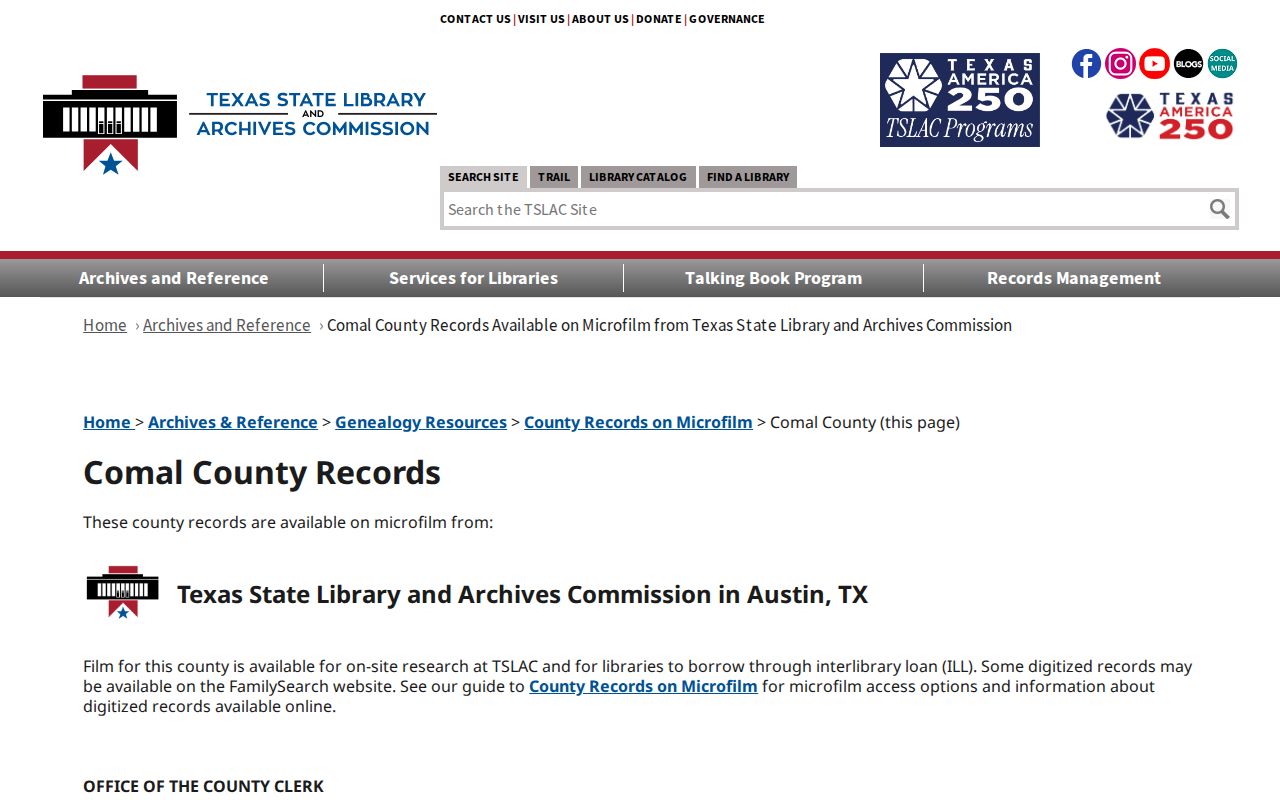
TSLAC notes a local catalog quirk: there is no Volume J in the listed Comal deed series or probate minutes, and no A in the probate-record series. A skipped letter is a catalog fact, not proof that a transfer or estate file never existed. Request the listed reel or volume range, retain the citation, and keep an unresolved gap visible in the timeline.