
New Braunfels Previous Residents by Era
The earlier household trail is best traced by matching the source to the time period. Modern parcel and deed tools establish a property identity and recorded transfer trail. Historical directories and telephone books add dated address associations. Census, newspaper, cemetery, probate, and map sources can explain a family change or a building’s earlier use. The Comal record set has uneven online coverage, so the table begins with confirmed date ranges and makes the microfilm fallback visible. A New Braunfels mailing address can also fall in Guadalupe County, making county verification an early requirement rather than an afterthought.
| Source | Years it covers | Where held | What it can show |
|---|---|---|---|
| ROAM official-record index | “Sovereignty–Present”; exact modern cutoff not located | Comal County Clerk online portal | Recorded parties, instrument type and number, date, legal description, volume or page, and image route |
| Comal deed records and indexes | Deeds 1846–1901; direct/reverse indexes 1846–1895 | TSLAC microfilm or interlibrary loan | Earlier recorded transfer trail when the online path needs a historic bridge |
| New Braunfels city directories | 1931; 1940; 1952–53; 1960s–1990s holdings | Sophienburg Museum & Archives | Dated household, address, or business association |
| Telephone directories | 1928, 1937, 1945, 1947, 1950, and 1952 examples | Sophienburg and UT catalog holdings | Telephone and address context around a directory year |
| Sanborn maps and local census aids | Maps for 1907, 1912, 1922, 1930, 1949, 1969; CCGS census 1850–1930 | LOC workflow, city reports, and CCGS | Structure, street, use, and historical household context |
| City permit search | Current public portal; historical start date not located | New Braunfels Development Services | Permit address, type, applicant, contractor, and submitted date where returned |
Start near the present when a deed chain is needed. Start with a dated directory, census, or newspaper source when the question is about a family at a known historical time. The TSLAC Comal County guide identifies the older microfilm and interlibrary-loan bridge. The two trails meet only after their dates, parcel identity, and address wording are compared.
New Braunfels Address Jurisdiction First
Before searching a New Braunfels historical address, confirm where the parcel sits. The city’s mailing label does not prove city-limit status, and New Braunfels reaches into both Comal and Guadalupe County records environments. City GIS lists Counties, CityBoundaries, ParcelsOutsideETJ, Parcels, Subdivisions, and Zipcodes layers, while Comal CAD supplies the situs, property identifiers, and legal-subdivision fields for its jurisdiction. That cross-check prevents a long Comal deed search for a parcel whose controlling county record is elsewhere.
Use the current address as a locator, not as the only historic key. Units, private roads, postal routes, parcel splits, replats, and address changes can disturb a simple street-number search. Record the situs address, parcel or geographic ID, subdivision, block, lot, and legal description when available. The legal description is the durable bridge between a modern address label and an older deed or plat.
Note: A New Braunfels mailing address can span city, ETJ, county, and ZIP boundaries, so save the jurisdiction source and date.
New Braunfels Previous Resident Deed Chain
The deed chain for a New Braunfels address starts with a tax-roll and parcel check, then moves into recorded instruments. Comal Appraisal District Property Search accepts owner name, street number, street name, property ID, geographic ID, subdivision, and other fields. The owner name is a tax-roll relationship, not a statement about who occupies the property. Use it to obtain the situs and legal identity, then search Comal County ROAM for the recorded purchase and earlier transfer documents.
- Find the parcel in CAD and record its situs, property or geographic ID, subdivision or legal description, and the tax-roll owner name.
- In ROAM, look for the tax-roll owner as grantee or buyer, using name and date windows, instrument details, or legal-description terms as needed.
- Save the purchase document number, recording date, document type, grantor or seller, grantee or buyer, volume or page reference, and legal description.
- Search the seller from that deed as a grantee in an earlier transaction, then repeat the comparison one transfer at a time.
- When the trail reaches older material or an online gap, request the correct TSLAC reel or send the Clerk a targeted record request with known identifiers.
- Grantor and grantee
- The grantor is the party transferring an interest. The grantee is the party receiving it.
- Chain of title
- A dated sequence of recorded transfers for the same legal parcel, checked one document against the next.
- Legal description
- The recorded land description, often using subdivision, block, lot, tract, or survey terms. It can remain useful when a street address changes.
- Situs address
- The property location used in an assessment or parcel record. It is distinct from an owner’s mailing address.
ROAM describes records as “Sovereignty–Present,” but research did not identify an exact earliest modern calendar year. Its free preview is watermarked and unofficial; official images cost $1 per page. When an image or older record is unavailable in the portal, the County Clerk’s written research form accepts document number, volume or page, type, date, grantor, grantee, and legal description, with a focused request preferred over a general sweep.
ROAM’s official-record search is the source shown below. The portal route supports a transaction trail, but the recorded image and Clerk-certified copy remain distinct access products.
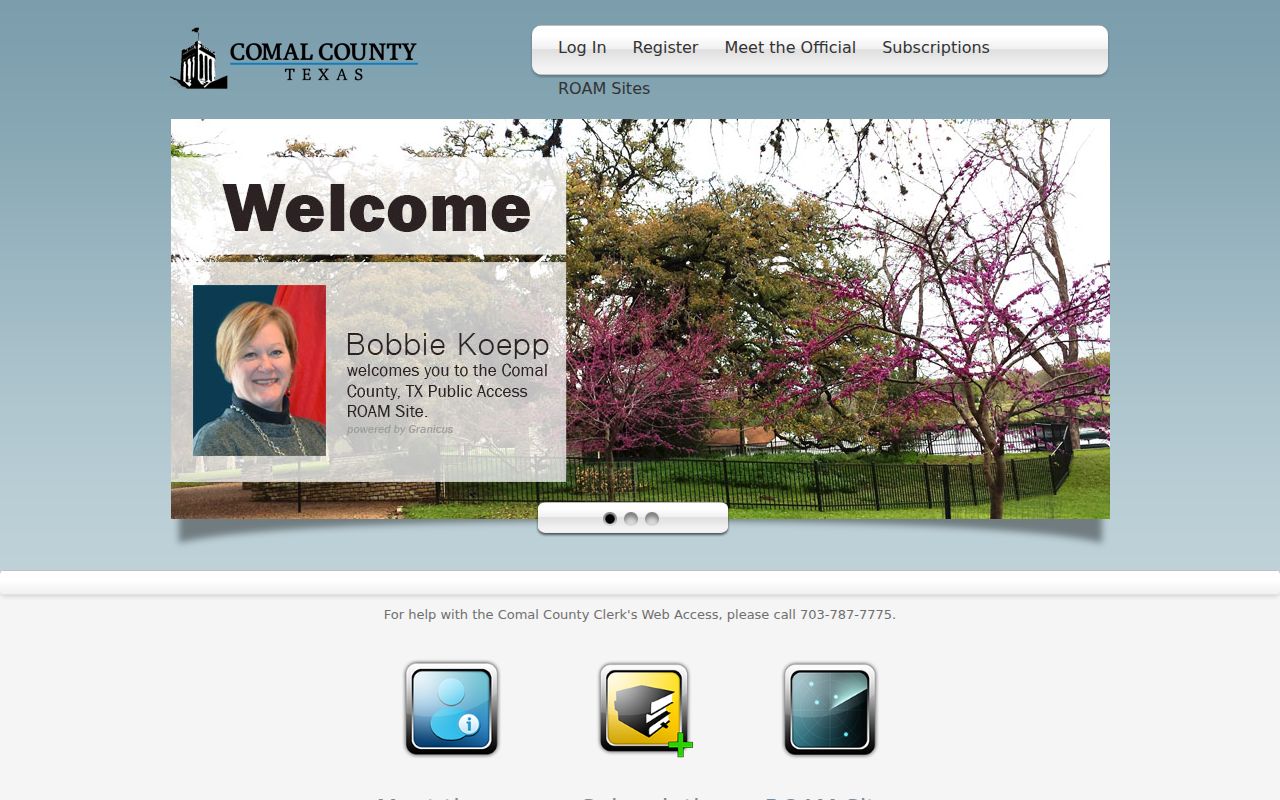
A recorded transfer identifies document parties and parcel evidence. It does not by itself prove that either party lived at the situs address. Keep ownership evidence and past-household evidence in separate columns.
New Braunfels Plats Protect Old Addresses
A recorded plat can keep an old address trail from drifting to the wrong lot. The Comal County Plat Viewer maps recorded plats and revisions. It helps reconcile the subdivision, phase, block, lot, replat, easement, and tract layout shown in CAD or a deed legal description. The downloadable plat is unofficial. A certified copy comes from the County Clerk, and the research directs readers to use the recorded revision when a legal conclusion depends on lot numbering.
Street numbers are not a legal boundary. A similar number may sit on a corner lot, an alley, a reserve tract, or a different subdivision phase. Compare the plat’s exact labels with the deed and CAD record before carrying a past household from one address form to another.
New Braunfels Past Resident Households
Deeds identify a recorded transaction. Directories, telephone books, census schedules, and local notices supply the household layer for a New Braunfels address history. Sophienburg documents directories for 1931, 1940, 1952–53, and later decades, plus telephone examples from 1928 through 1952. CCGS publishes searchable leads for censuses from 1850 to 1930 and a reconstructed 1890 census. These are separate sources with different dates and editorial limits, so a name should not be promoted from one source into an asserted resident history without a second, compatible record.
- Choose the directory or telephone-book year nearest the deed or family event.
- Copy the name, address, year, and exact spelling before checking another source.
- Use the closest available census record or CCGS index to test the household, age, birthplace, or family context.
- Compare the recorded parcel description with the historic address, noting any unresolved variation.
- Close a dated household trail with a newspaper, cemetery, probate, or church source only when it clearly relates to the same person or address.
The documented historical shelf and its access limits are detailed in the New Braunfels city directory collections. A directory line is a historical association, not a guarantee of ownership or present occupancy. A missing line can also reflect a name variant, a business listing, a non-digitized volume, or a publication gap.
New Braunfels Previous Resident Map Dates
For an address with a long physical history, maps can date the structure without naming the people who used it. The Library of Congress Sanborn search guide supports searches by state, city, edition date, sheet, and notes. New Braunfels historic reports identify local editions for 1907, 1912, 1922, 1930, 1949, and 1969. Those sheets can show a building’s footprint, materials, use, street relationship, and hazards. They are useful beside a deed and directory because they answer a different question.
The Dry Comal Creek historic-resource report shows why this distinction matters. It records industrial or commercial activity on earlier map years but no directory address from 1952 through 2016. A blank directory result does not erase an address history. It may point to a commercial site, a changed address, a different index heading, or a place that was not listed as a household.
Note: Treat a Sanborn sheet as map evidence for structure and use, not as proof that a named person lived there.
New Braunfels Previous Resident Evidence Example
The City historic file for 794 W. Mill shows a local way to connect sources without collapsing them. It associates Theodore and Margarete Schwab with a 1923 telephone directory and a 1931 city directory. It also cites Henry Hoeke’s plat, Book Z, Page 295 from 1900, a J.W. Combs purchase on August 22, 1901 for $350, and a Schwab purchase on October 6, 1902 for $400. The same file says Sanborn coverage begins for the address in 1922. Each part carries a distinct role: directory for historical address context, deed for transfer, and map for physical context.
This is a model for source order, not a claim about any current occupant. A New Braunfels address-history file should keep the original source, date, record type, and exact conclusion alongside every link. That makes later review possible when an address number, surname, or parcel description changes.
New Braunfels Past Resident Endpoints
Older address trails often end in records about death, burial, estate administration, or a move. Sophienburg’s newspaper microfilm includes near-complete Neu-Braunfelser Zeitung coverage from 1852 to 1957, New Braunfels Herald from 1895 to 1957, and Herald-Zeitung from 1957 forward. CCGS publications include cemetery, marriage, naturalization, and probate leads. TSLAC lists probate series from 1846 onward. A New Braunfels cemetery result can add plot and burial context, while probate can identify an estate event. Neither source is a substitute for a dated address record.
Lawful use. Research on previous residents belongs to family history, estate questions, property history, and personal curiosity. Do not use historical or current records to track, harass, or harm a living person.
Use a targeted County Clerk request when a deed, plat, or probate record is missing from the online path. The Clerk asks for specific identifiers and says one to three requested documents may take up to 24 hours, while three or more may take up to 48 hours. Texas Public Information Act requests should seek existing records from the correct custodian, not ask an office to compile a new people list.